Why Now Is the Moment...
In 1982, Milton Friedman — the economist whose neoliberal framework reshaped the global economy and won him a Nobel Prize — wrote something that has proven to be the most honest thing ever said about how power actually works:
"Only a crisis — actual or perceived — produces real change. When that crisis occurs, the actions that are taken depend on the ideas that are lying around."
He wasn't describing an accident. He was describing a strategy.
Naomi Klein spent years documenting that strategy in The Shock Doctrine. Her conclusion: every major rollout of free-market economic policy in the last fifty years — privatisation, deregulation, the dismantling of public infrastructure — was delivered not through democratic consensus, but through crisis. Real crises and manufactured ones. Economic collapses, coups, natural disasters, wars. Moments when people are disoriented enough that ideas which would never pass in normal times get pushed through before anyone can organise to stop them.
The shock creates the opening. The ideas lying around fill it.
We are in one of those moments right now. Economically, politically, environmentally — the shocks are arriving faster than institutions can absorb them. The far right is organised and has its ideas lying around. The question for everyone else is: do we?
The NQ Regional Microfactory Co-Operative is our answer to that question. Community owned and run assets for one of the biggest resources in Australia, if not the planet. WASTE.
The Neoliberalist Economic Framework
Friedman's framework — neoliberalism — is not just an economic theory. It is a transfer of power: from communities and governments to capital. From the public to the private. From the many to the few.
It was tested first in Chile in 1973, delivered through Pinochet's military coup. It was applied in the United Kingdom under Thatcher, in the United States under Reagan, across Eastern Europe after the fall of the Soviet Union, and in country after country that received IMF loans with conditions attached. The conditions were always the same: privatise public assets, cut social services, deregulate markets, reduce wages, and open the economy to foreign investment.
The theory said this would create prosperity. What it created was the largest transfer of wealth upward in modern history.
The mechanism was always crisis. The strategy was always the same: move fast, before people understand what is being taken from them. Friedman's student Naomi Klein reframed his own observation back at him: the ideas that fill a crisis don't have to be his.
Someone else put it this way: ideas are an alternative waiting on a crisis as a catalyst for change.
That reframe is everything.
Who Has Been Running This Playbook — and Who Hasn't
The right has been organised around this idea for decades. The think tanks, the donor networks, the ready-made policy documents, the talking points prepared in advance and waiting for the moment to deploy. When the Global Financial Crisis hit in 2008, the response was austerity — cuts to public services, bail-outs for banks, and the cost loaded onto ordinary people. Not because that was the only option. Because it was the idea lying around.
The left, historically, has been better at critique than at ready alternatives. Better at identifying what is wrong than at having something concrete, operational, and scalable waiting to go when the window opens.
That is the gap the co-operative movement — at its best — has always been designed to fill.
Co-operatives are not new. They are the oldest form of democratic economic organisation on the planet. They predate the corporation. They have survived depressions, wars, and waves of privatisation that dismantled everything around them. The Mondragón co-operative in the Basque Country has been operating since 1956 and now employs over 80,000 people across manufacturing, retail, finance, and education. The Emilia-Romagna region of Italy — one of the wealthiest and most economically resilient regions in Europe — runs on a co-operative economy that accounts for roughly 40% of its GDP.
These are not experiments. They are proven models that work — and that have been deliberately marginalised in the policy landscape because they do not generate returns for the investor class.
Where This Lands in 2026
The shocks are not hypothetical. Fuel prices in remote Queensland hit $4 a litre before global oil market instability caused by an illegal war pushed them higher. Some are callign it the Cold War II.
Three tonnes of plastic collected from a beach cleanup on Cape York that due to no other solutions head straight to landfill because there is no local infrastructure to do anything else with it. The current solution is being stockpiled in warehouses just south of Townsville and is paid by the tax payer from $4 for a domestic tyre and is part of the 48% of illegally dumped waste.
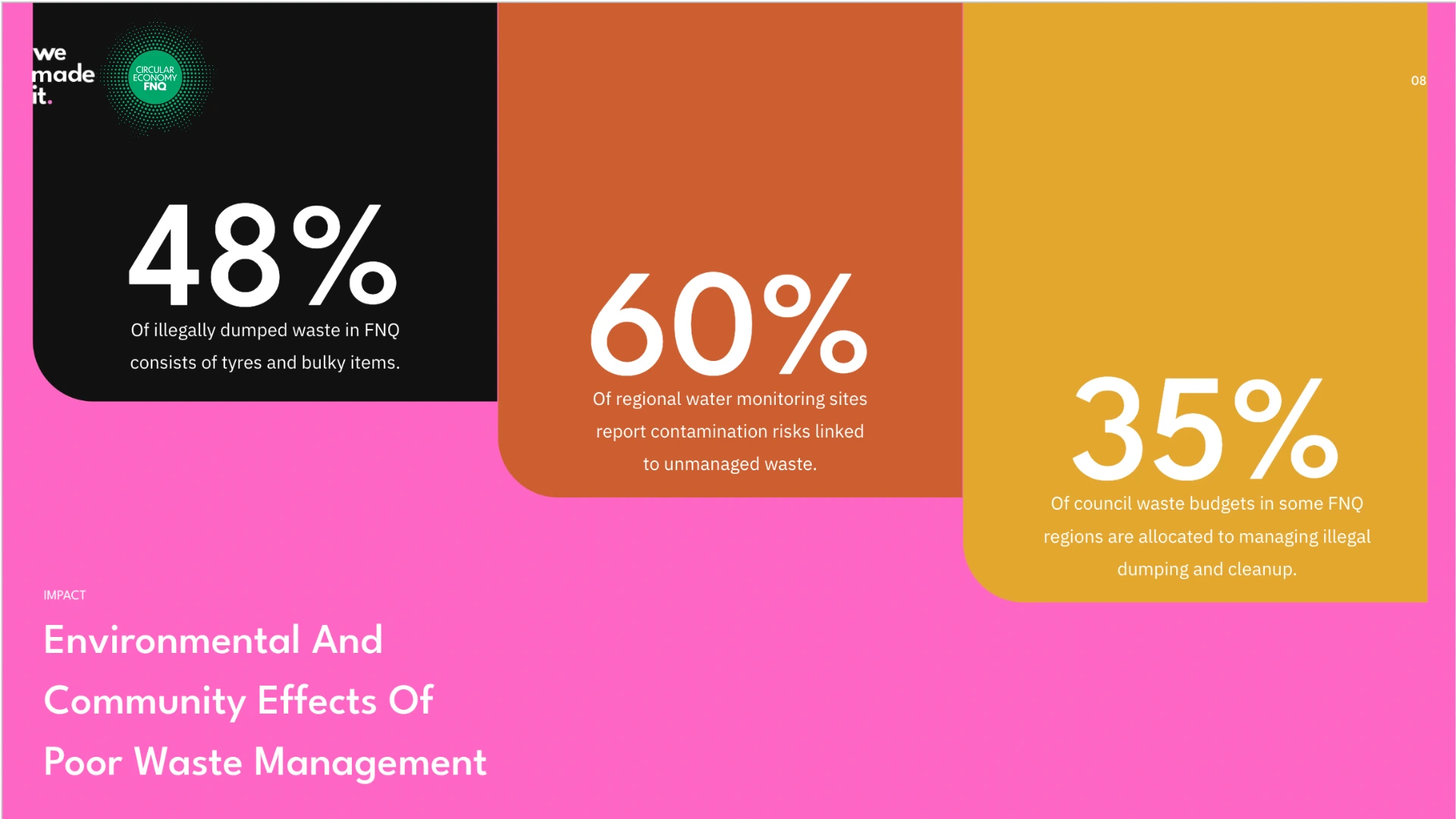
Forty-eight million end-of-life tyres are stockpiled across Australia with no viable national solution. The costs of the linear economy — extraction, pollution, waste, displacement — are being paid disproportionately by the communities least responsible for creating it.
Meanwhile, the policy response is slow, the investment goes to cities, and the ideas that get funded are the ones that maintain the existing power structure.
The crisis is real. It is not coming — it is here. And it is arriving inside communities that have been told for generations that the solution is somewhere else, owned by someone else, and will get to them eventually.
It won't. Not unless the ideas lying around are different ones.
When the Window Opens
Friedman was right about one thing: the window created by crisis is real, and it is narrow. The people who are ready when it opens are the ones who shape what comes next.
The NQ Regional Microfactory Co-Operative is not waiting for a government tender or a billionaire's philanthropy or a policy framework to align. It is being built now, in the formation period, by founding members who understand that the infrastructure of the next economy has to be built before the crisis fully arrives — not after.
The co-operative model is specifically designed to resist the shock doctrine. It cannot be acquired by a corporation and stripped for parts because it is owned by its members, governed by its members, and its surplus is distributed to its members. It is not a startup looking for an exit. It is a community institution built to outlast the economic weather.
When the next shock hits — and it will — the ideas that are lying around in regional Queensland will include a functioning, member-owned circular economy infrastructure that produces local fuel, distributes local income, and demonstrates that you do not need a global supply chain to live well.
That is not a small thing. That is the alternative.
How You Become the Alternative That's Ready
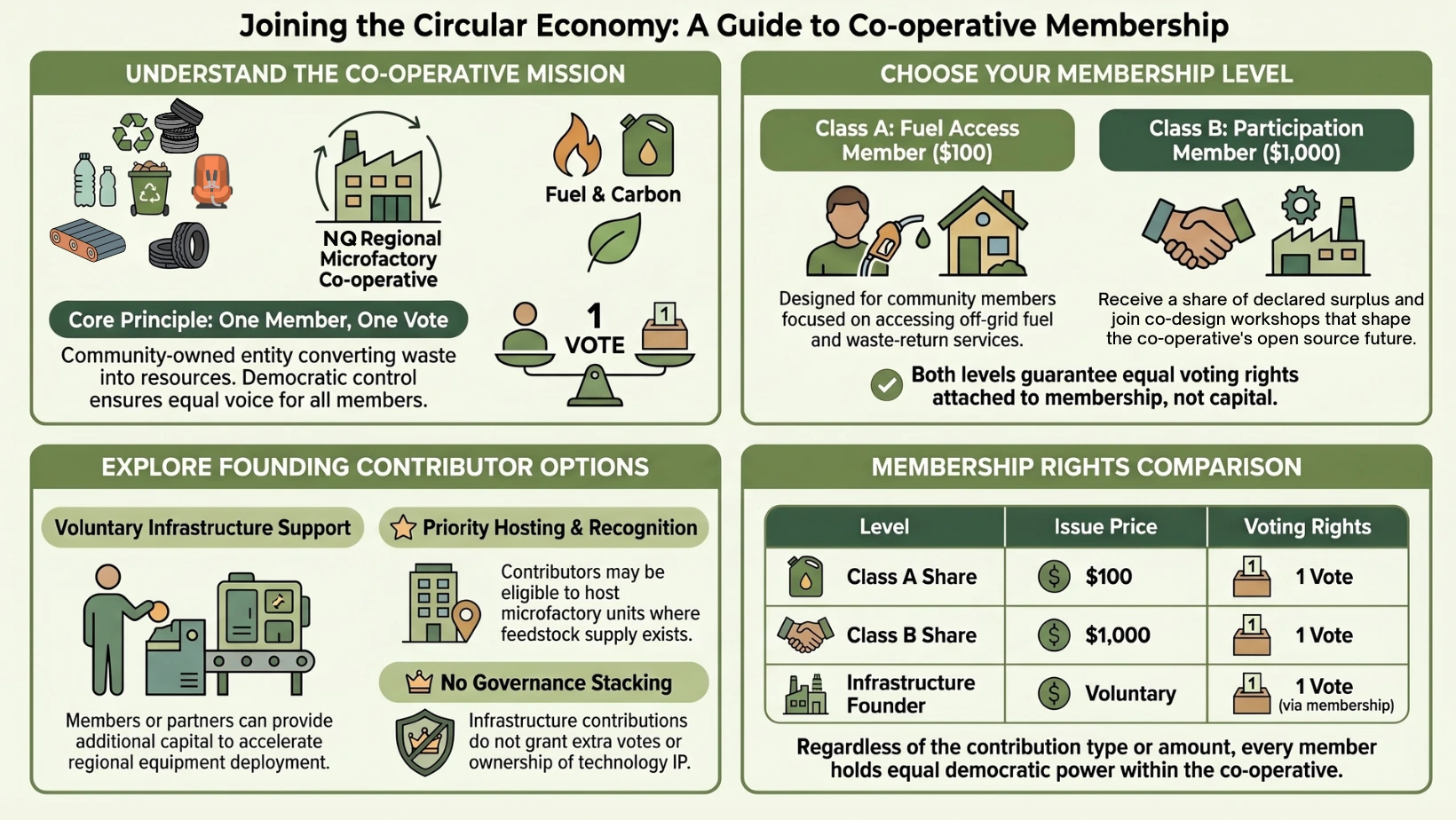
You join now, before registration is complete, as a founding member.
You understand that a $100 Class A membership or a $1,000 Class B membership is not a donation and not an investment in someone else's company. It is a stake in infrastructure that your community owns, governed by rules that you help shape, producing outputs that stay local.
You understand that the co-operative does not need every person in the region to believe in circular economics or Naomi Klein or the failings of neoliberalism. It needs people who want cheaper fuel, better waste solutions, and a share in the value that their community generates. The economics work without the ideology. But the ideology is worth being honest about — because the people building the shock doctrine have always been honest about theirs.
Friedman said the actions taken in a crisis depend on the ideas lying around.
This is us putting our idea down. Right here. Ready.
NQ Regional Microfactory Co-Operative Ltd is a distributing co-operative being formed under the Co-operatives National Law (Queensland). Membership opens upon registration.
Further reading: Naomi Klein, The Shock Doctrine: The Rise of Disaster Capitalism (2007). Milton Friedman, Capitalism and Freedom (1982 preface).
/