How it works
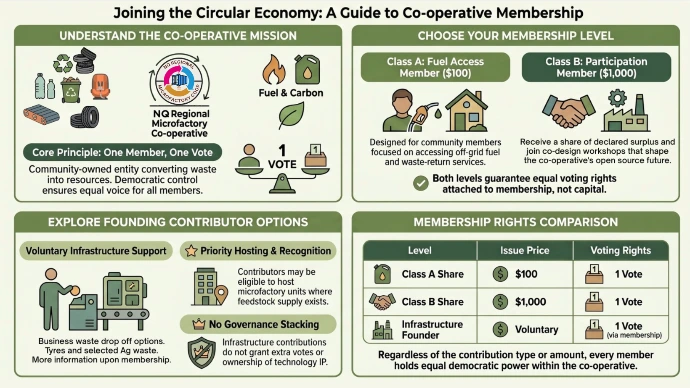
One member, one vote.
No matter which share you hold, every member has an equal say. Membership is capped at one share per person, so the co-op stays participation-driven, never capital-driven.
Your voice decides where the money goes. This is what membership actually means here: 40% of the Co-operative's surplus goes to community projects — and members propose and prioritise which ones. Not a head office in another state. A $100 Class A member has exactly the same vote in the Co-operative as anyone else.
Members power the supply chain.
You stay an active member by doing any one of these: supplying approved waste streams to co-op hubs, purchasing outputs like bio-fuel and materials, taking part in governance, or joining our education and training programs.
Radical transparency.
Our entire operation runs on an ERP platform — with an auditable ledger tracking feedstock volumes, transactions, and surplus allocation. Members can see exactly where the value flows: 70% of operational value stays with their local chapter, then that is 100% of Co-Op funds where we then have 10% for a Fire Extinguisher Account, 30% of surplus to Class B members and then of the remain 60%, 40% of surplus goes to member-voted community projects, and 20% of net surplus is ring-fenced for the Housing Security Fund. Tiny House Village anyone?
Ways to join
Class A — Community Member Share · $1,00
For residents. Your share gets you: free waste deposits of tyres at co-op hubs (no gate fees — drop your end-of-life tyres at no cost), plus full voting rights, including your vote on how the 40% community surplus is spent. One share, one vote, a real say in your region's circular economy.
Class B — Microfactory Participation Share · $1,000
Design Odoo templates easily with clean HTML and Bootstrap CSS. These templates offer a responsive, mobile-first design, making them simple to customise and perfect for any web project, from corporate sites to personal blogs.
Founding Infrastructure Contributor · $5,000
For local businesses, philanthropists, and aligned organisations who want the first microfactory built. A voluntary, non-refundable contribution to the Co-operative's objectives — it confers no entitlement, benefit, priority, or extra votes, because democracy isn't for sale.
Donation Class A Membership · $100
Gift a Class A share into the community. You fund a membership; the region gains a member. We also identify where to go to next as we see where there is a appetite for this model to be deployed next.
Who What Where When
Why 🥸
In Canberra, politicians are arguing over whether to tax gas exports at 25% — a debate about how to redistribute the value of resources after it leaves the regions that produce it.
We took a different path. We built an economic model where 70% of the value of every microfactory's outputs — off-grid biofuels, biogas, and advanced materials — is retained by the Co-operative and its regional chapters from day one. No levy to legislate. No windfall to argue over. No waiting for redistribution. The value never leaves.
Every year, Far North Queensland ships its waste problem somewhere else — and ships the value of that waste out with it. Instead of waiting for government grants or drawn-out EOIs, we're funding the first microfactory the co-operative way: through our own community. Local residents, businesses, and organisations pool capital, supply the waste inputs, buy the outputs, and share the benefits — with every dollar tracked transparently.
Whatever your view of the tax debate, one thing is hard to argue with: a region that owns its own production doesn't need to win an argument in Canberra to keep its wealth at home.
Where we're building 🌏
Our regional cluster strategy grows chapter by chapter: Cassowary Coast is the first Transfer Station to have a Microfactory, then we have other Councils: Croydon, Cook Shire, Mareeba, and the Tablelands at the table post the ESG and ISO59020 data from Microfactory 1, expanding the network reporting from Townsville to the Torres Strait.
Who's behind it 💃🏽
The Co-operative was formed on 7 April 2026 under the Co-operatives National Law (Queensland), within the Circular Economy FNQ ecosystem. The microfactory processing technology (MAP Technology) is developed by We Made It Better for the Planet Pty Ltd (WMI) and sub-licensed to the co-op — 70% of operational value is retained by the Co-operative, with 30% payable to WMI as a technology royalty. Our facilities are also designed to operate as live STEEM training environments with regional education partners, when available.
When ⏰
January 2027, with free Tyre drop off beginning by September 2026 at Cassowary Coast Council. Other councils will take part in 2027 driven by where the memberships are sold.
What 🏭
A true Microfactory, 180kgs of waste per day, that operates out of 2 shipping containers.