Why the Future Needs a Different Aesthetic
The dominant image of the future is wrong.
For the last forty years, the story we've been told about what comes next has oscillated between two poles: techno-utopia — clean white towers, smart cities, billionaires in orbit — and collapse. Neither of these futures is designed for the people who actually live here. Neither of them is built by communities. Neither of them is owned by anyone except the people who already own everything.
Solarpunk is the rejection of both.
It is a vision of a future that is lush, not sterile. Distributed, not centralised. Governed by the people who live in it, not managed for the people who profit from it. It is a future where the infrastructure of daily life — energy, food, water, waste — is woven into the community rather than extracted from it. Where technology serves ecology rather than replacing it. Where the circular economy is not a policy framework but the way things simply are.
That future is not science fiction. It is a design brief. And the question — the only question that actually matters — is: who builds it?
What Solarpunk Actually Is
Solarpunk is not just an aesthetic, though the aesthetic is real and worth paying attention to: solar panels on community halls, food forests threaded through urban streets, water management that works with catchment rather than against it, buildings that breathe.
It is a political and economic philosophy built on a core premise: that the ecological crisis and the equity crisis are the same crisis. That you cannot solve one without solving the other. That a future which is clean but privately owned and centrally controlled is not a solarpunk future — it is just green capitalism wearing different clothes.
The infrastructure of a solarpunk future is community-owned. The governance is democratic. The technology is open. The surplus stays local.
These are not radical ideas. They are the ideas behind every successful co-operative, every commons-based peer production project, every open source software movement that ever turned a tool into a public good. Solarpunk is what happens when those ideas stop being contained to specific sectors and start becoming the default logic for how communities organise their relationship with the physical world.
Who Builds It — And Why Open Source Is the Key
The climate crisis will not be solved by the same concentration of capital and control that created it. This is not ideology — it is engineering. Concentrated systems are fragile. Distributed systems are resilient. A future built on a handful of proprietary technologies, owned by a handful of corporations, and accessible only to communities that can afford to pay is a future that fails at the first shock.
Open source is the alternative logic.
In software, open source has already demonstrated what collective intelligence produces when it is not constrained by intellectual property walls: Linux powers the majority of the world's servers. Apache runs half the web. Firefox changed what a browser could be. Wikipedia replaced encyclopaedias. Not because these projects were better funded than their proprietary competitors — in most cases they were worse funded. Because the collective intelligence of thousands of contributors, iterating in public, sharing improvements without restriction, produces something that no single organisation can match.
The same logic applies to physical infrastructure.
Open source hardware — open source designs for solar installations, water systems, manufacturing equipment, waste processing — means that a community in Far North Queensland and a community in rural New South Wales can build on each other's work rather than starting from scratch. Every improvement made in one node becomes available to every other node. The knowledge doesn't stay in one place. The design doesn't belong to a shareholder. The blueprint is the commons.
The NQ Regional Microfactory Co-Operative is built on this premise from the ground up. The MF1 microfactory design, the processing protocols, the governance templates, the business model — these are not trade secrets waiting to be protected by a patent. They are the seed of a public infrastructure, designed to be shared, replicated, and improved by every community that picks them up.
When a co-operative in Innisfail as a #transitiontown solves a problem with feedstock logistics, that solution becomes available to a co-operative in Armidale. When a community on Cape York develops a governance structure for managing tyre collection at the node level, that structure can be adapted by a community in the Hunter Valley. The collective intelligence of the network makes every node smarter than it could be alone.
This is how you build a solarpunk future. Not from the top down. From everywhere, at once, with the knowledge shared freely.
Where This Is Already Happening
The NQ Regional Microfactory Co-Operative is not the only thing being built.
Circular Economy FNQ — the social enterprise that sits alongside the co-operative and anchors the broader network — is already registered on the Buy NSW Government's Social Enterprise database. That registration is not incidental. It is a tender credential. It means that when New South Wales councils begin looking for community-led circular economy infrastructure — and they are already looking — Circular Economy FNQ is a recognised, credentialed entity that can respond.
The work is starting in Far North Queensland because that is where the need is most acute, the feedstock is most concentrated, and the community infrastructure exists to support a founding cohort of members. But the architecture of what is being built here was always designed to scale.
Queensland is the proof of concept. New South Wales is next.
And New South Wales is not a small thing. It is the most populous state in Australia. Its councils manage some of the largest volumes of waste in the country. Its agricultural regions face the same tyranny of distance, the same absence of local circular infrastructure, and the same dependence on distant processors that sends value away from the communities generating it. The problems are identical. The solution — community-owned, open source, co-operative — is transferable.
Emilia-Romagna in Italy didn't become a co-operative economy because one co-operative succeeded. It became one because the model proved itself and spread — because the knowledge was shared, the governance templates were replicated, and the economics worked well enough that the next community didn't need to reinvent the wheel. The Mondragón network in the Basque Country grew from a single technical college and a handful of workers in 1956 to 80,000 employees across manufacturing, finance, and education by building on itself.
Regional Australia has the same opportunity. The difference is that the knowledge doesn't have to travel by word of mouth any more. It travels through open source repositories, through co-operative governance frameworks built to be replicated, through a social enterprise registration that lets councils in Wollongong and Wagga Wagga engage with the same model that is being proven right now in Cairns and Innisfail.
When the Architecture Has to Be Built
There is a window.
Australia's National Waste Policy commits to an 80% resource recovery rate by 2030. State and local governments are under increasing pressure to demonstrate circular economy outcomes — not just recycling rates, but genuine closed-loop material recovery that keeps value local. The Product Stewardship framework for tyres is tightening. Carbon accounting requirements are making the cost of linear extraction visible in ways they never were before.
This is the moment when the infrastructure question becomes urgent. And the communities that have built the infrastructure — that have the operating nodes, the governance structures, the supply chains, and the open source blueprints ready to share — will be the ones that shape what gets built and who owns it.
If that infrastructure is built by corporations, it will be owned by corporations. The surplus will flow to shareholders. Communities will be customers of a service, not co-owners of the system.
If it is built by co-operatives, under open source principles, governed by the people who live and work in these places — the surplus stays. The knowledge stays. The infrastructure stays. And the next shock — economic, ecological, or political — finds communities that are more resilient, not more dependent.
How You Join the Architecture
The solarpunk future is not a prediction. It is a practice.
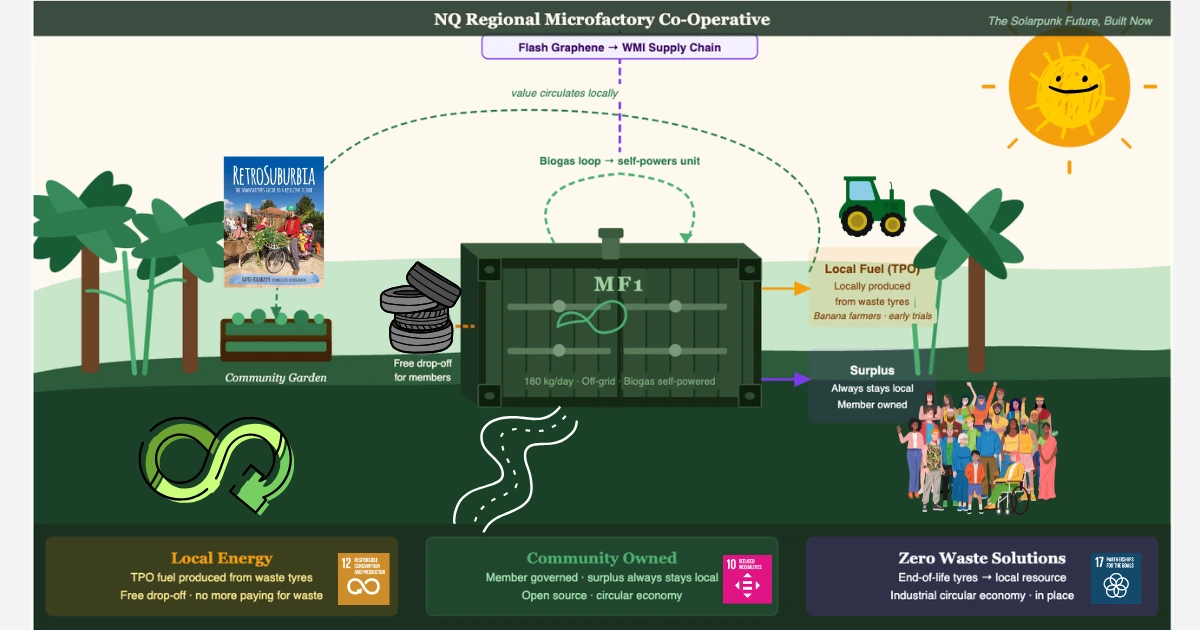
It is built by founding members who join the NQ Regional Microfactory Co-Operative now, before registration is complete, and who understand that their membership is not a transaction — it is a stake in community infrastructure designed to be shared.
It is built by councils in Queensland and New South Wales that recognise Circular Economy FNQ as the credentialed social enterprise partner they have been looking for — and who choose community-owned circular infrastructure over the corporate alternative.
It is built by farmers on the Atherton Tablelands and in the Hunter Valley who want a supply chain that isn't owned by a duopoly. By mechanics in Mareeba and Armidale who want their tyre stockpiles processed locally, not trucked south at their cost. By engineers and designers who want to contribute to open source hardware that actually gets built and deployed, not filed in a patent registry.
The solarpunk future is not waiting for a government program or a billionaire's philanthropic impulse or a technology that hasn't been invented yet.
It is waiting for the people who understand that the most powerful force in a distributed system is not control — it is contribution.
Come and contribute.
If you are outside of NQ think about becoming a sponsor of a seat as that is how we know where to go next..
NQ Regional Microfactory Co-Operative Ltd is a distributing co-operative being formed under the Co-operatives National Law (Queensland). Membership opens upon registration.